
Indian MSP Crisis: Why Farmers Are Not Getting Fair Prices for Pulses
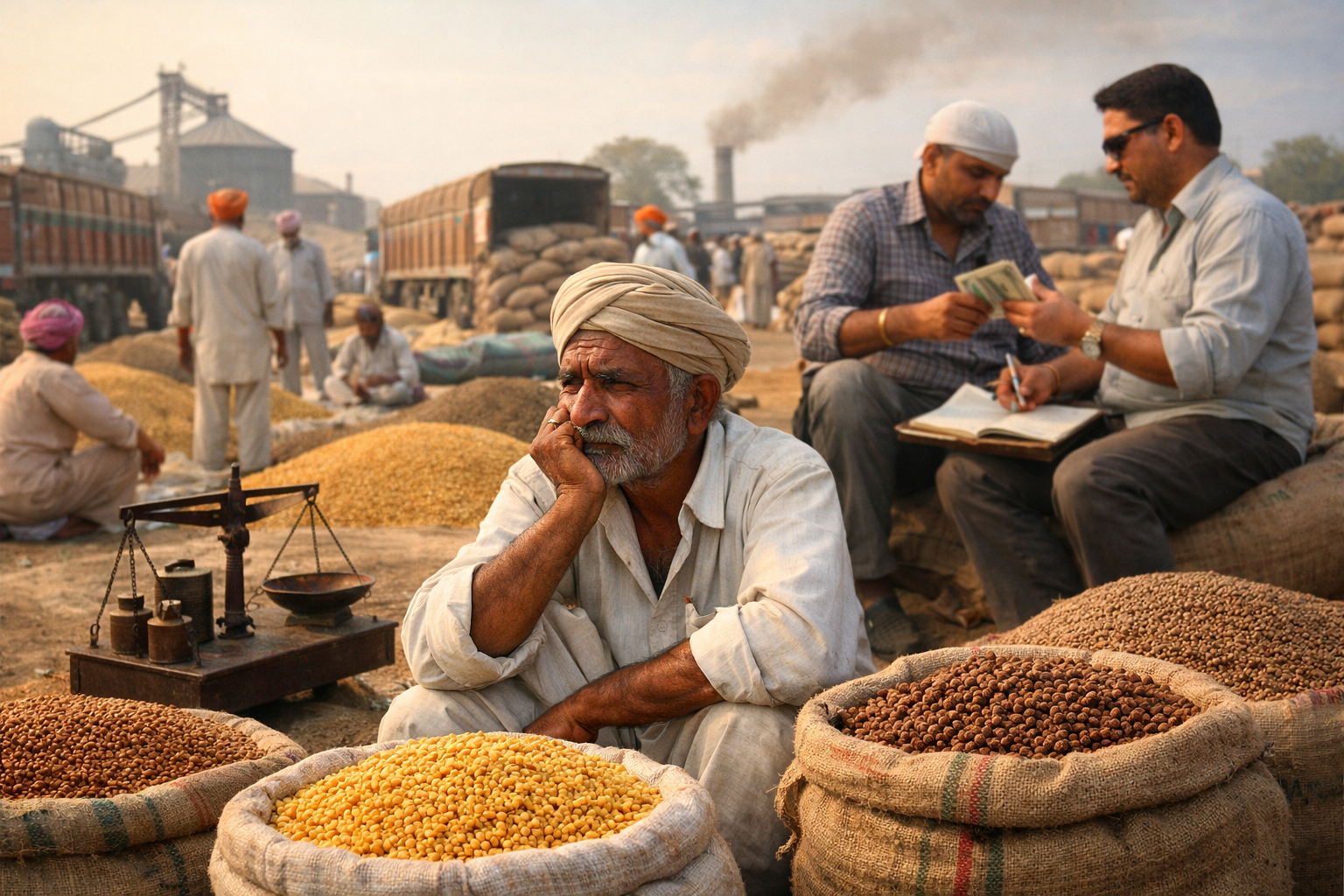
This rabi season, Indian MSP is back in the spotlight. While the government has fixed Minimum Support Prices for pulses—₹5,875 per quintal for chana and ₹6,700 per quintal for masoor—farmers in states like Karnataka, Maharashtra, and Gujarat are selling below these rates. In some markets, chana dal MSP is being ignored, with prices hovering between ₹5,000–5,400 per quintal. Similarly, masoor dal MSP is falling short in the mandis, leaving farmers frustrated.
Why Farmers Are Not Getting MSP
There are three main reasons why Indian MSP is not translating into real income for farmers:
- Bumper Production: This year, pulse crops saw excellent yields. Oversupply in mandis naturally pushed prices down. Even when MSP is legally guaranteed, a high volume of produce weakens bargaining power in open markets.
- Imports Undercutting Domestic Prices: India imports pulses like chana, masoor, and yellow peas from countries including Australia, Canada, and Myanmar. Most imports are duty-free (except moong), making foreign pulses cheaper than domestically produced ones. Farmers cannot compete with such low-cost imports, further lowering pulse prices.
- Slow Government Procurement: Government agencies like NAFED and NCCF are responsible for buying pulses at MSP under schemes like PM-AASHA. However, procedural delays, complex registrations, and insufficient local procurement centers mean many farmers sell in mandis before government purchases begin.
The Impact on Farmers
The gap between MSP and mandi prices is significant. Many farmers are forced to sell chana and masoor at 50–55 ₹/kg, far below MSP, simply to avoid storage costs and spoilage. This discrepancy affects farmers’ income directly, creating a paradox where higher production does not lead to higher earnings.
Solutions for Effective MSP Implementation
To make Indian MSP meaningful for farmers, coordinated measures are essential:
- Speed up Government Procurement: Establish procurement centers close to villages, simplify registration, and ensure timely payments. This reduces the need for farmers to sell below MSP.
- Balance Imports with Domestic Needs: Adjust import duties strategically to prevent cheap imports from undermining domestic pulses, while still keeping consumer prices reasonable.
- Promote Value Addition: Encourage Farmer Producer Organizations (FPOs) to process pulses into besan, packaged dal, or other value-added products. This ensures farmers earn more than raw commodity prices.
- Compensation Models: Schemes like Bhavantar, which pay farmers the difference between MSP and market rates, can provide immediate relief where physical procurement is difficult.
The Bigger Picture
Indian MSP is more than a number on paper—it is a promise of fair income for farmers. Without proper implementation, MSP becomes irrelevant, and the hardworking farmers face economic insecurity. A robust system that combines procurement efficiency, policy balance, and value addition can make MSP effective.
The pulse sector illustrates a critical lesson: protecting farmer income requires more than legal pricing—it requires an entire ecosystem of support. Only then can India ensure that MSP fulfills its true purpose, securing livelihoods and encouraging sustainable agriculture.