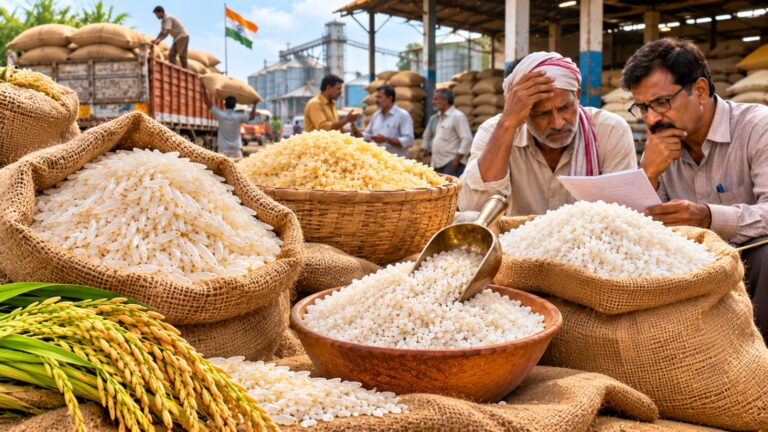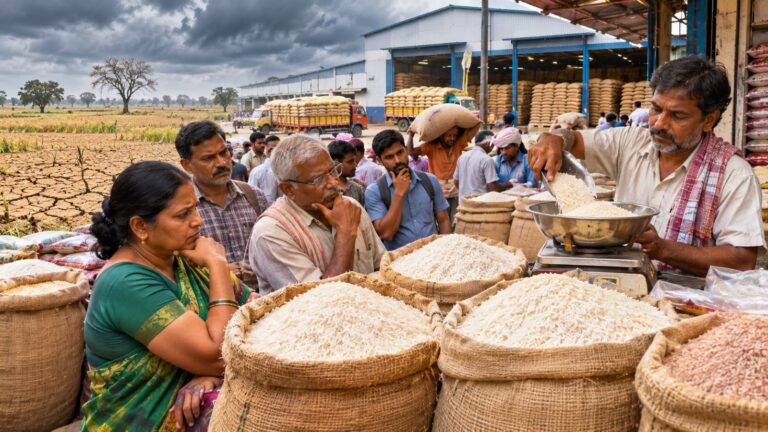

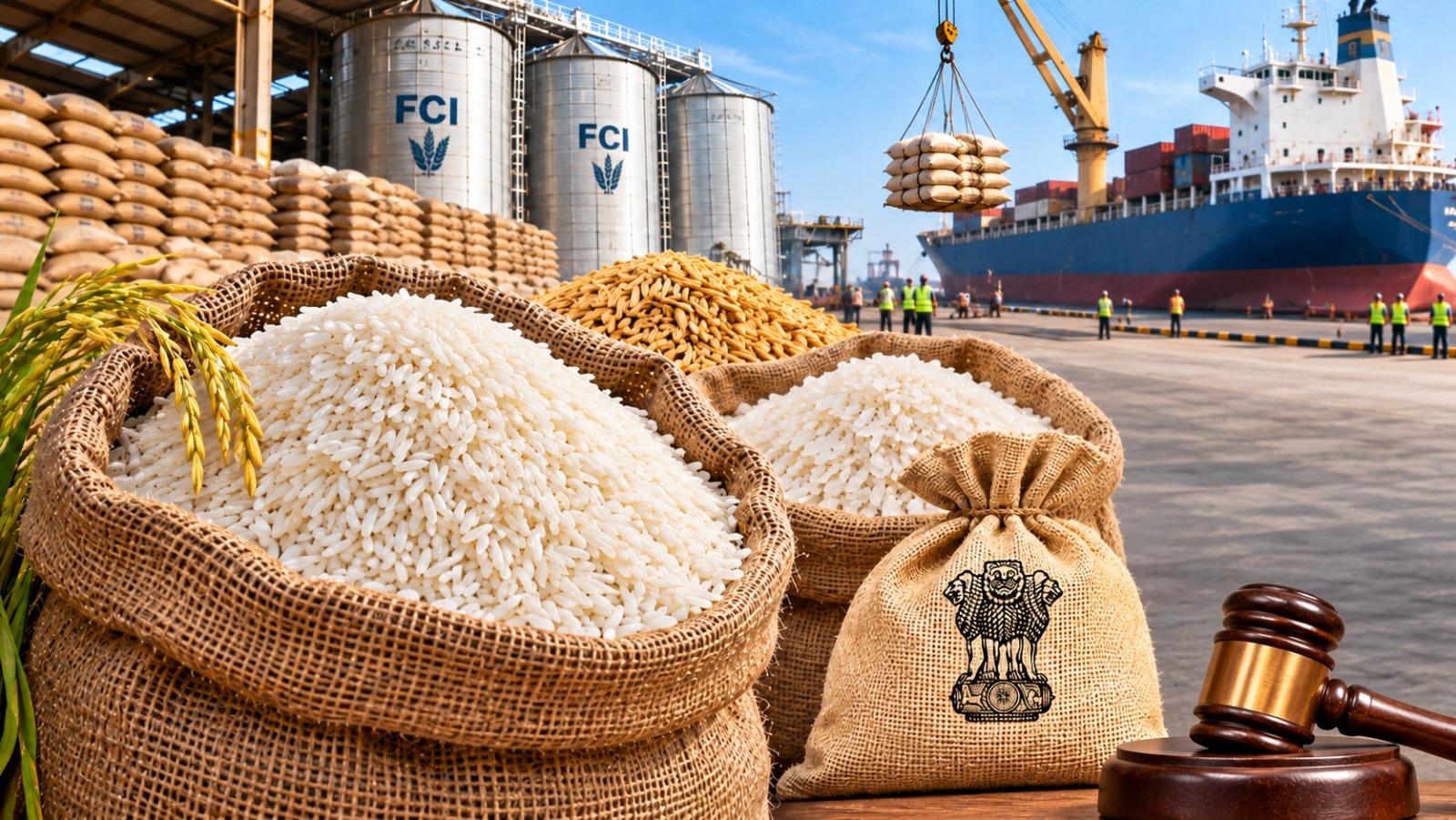
Despite high levels of government stock and extra supply from the Open Market Sale Scheme (OMSS), rice prices continue to rise.
As of November 25, 2026, the average rice selling price has risen over the last year by more than 9%, according to the Department of Consumer Affairs’ Price Monitoring Cell. Prices have also risen by approximately 2% in the last month.
October retail rice inflation was 12.51% – up from 8.27% in September. And this was despite the government’s decision to double the amount of rice available on the OMSS to 5 million tonnes (MT) for 2026-27.
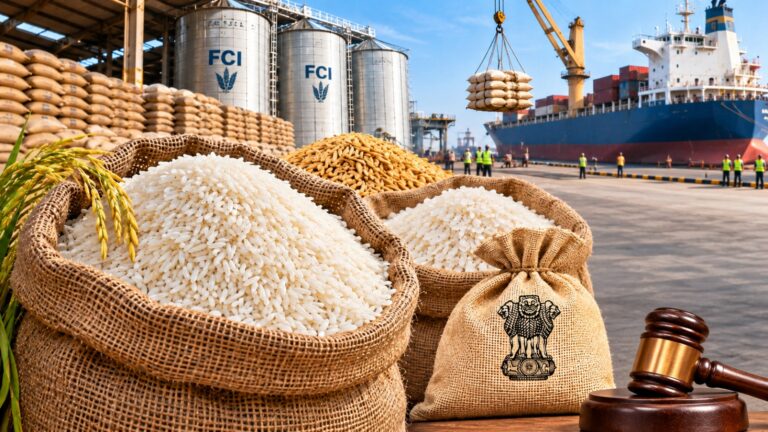
The Food Corporation of India (FCI) has stock equivalent to just under 37MT. The minimum stock level required for January 1 is 7.61MT. Millers also have 18 MT of stock.
Traders suggest that the average selling price for white rice has now risen to ₹53 per kg, up from ₹43 per kg a year ago.
Poor monsoons and falling paddy area
Concerns about reduced rice output has also been driving prices higher. Advance estimates show that kharif rice production for 2026-27 is set to fall by 2% to 121.91 MT. Last year it stood at 124.76 MT.
Paddy area fell by 4% to 42.68 million hectares for the 2026 kharif season. There was especially large reduction in areas under paddy in southern states including:
- Karnataka – 0.46 million hectares
- Telangana – 0.43 million hectares
- Andhra Pradesh – 0.18 million hectares
- Tamil Nadu – 0.15 million hectares
Further, there has been a near-26% shortfall in monsoon rainfall in southern India. This has impacted on production and is also adding to supply pressures for favoured types of rice in the south.
Supply pressure on southern India’s premium rice
Reduced production has been especially evident in southern India. Prices have risen significantly for favoured rice types such as Sona Masuri, Samba Masuri, RNR and Ponni in recent months.
For some of the premium rice types eaten in this region, prices have reportedly almost doubled in the last year.
Prices have also risen for other non-basmati rice types such as PR11, PR14 and Jeerakasala.
In order to ensure adequate supply and avoid overstocking, the government has requested that Andhra Pradesh, Karnataka, Kerala, Tamil Nadu and Telangana implement stock controls for rice and paddy.
High export demand intensifies supply pressures
India’s good value has helped to fuel strong export demand for non-basmati white and broken rice.
India’s overall rice exports rose by 4.6% year-on-year to $6.81 billion in April-October 2026-27.
Exports of non-basmati rice were up by 6.7% at 8.84MT, compared with 8.28MT last year. Specifically,
non-basmati white rice exports rose by in excess of 18% to 2.82MT; and broken rice exports jumped by over 73% to 0.98MT from 0.56MT.
India exported around 15MT of non-basmati rice in FY2025-26 for a value of $5.87 billion. This compares with 14.13MT worth $6.53 billion the previous financial year.
Indian exporters continue to be price-competitive. Indian non-basmati rice can generally be exported for around $390 per tonne, compared with around $415 for Pakistan, $480 for Vietnam and $495 for Thailand.
India has therefore been able to sustain export demand. However, as exports have grown, these too have become a consideration for the government in relation to domestic supply.
What export controls are being considered?
The government is looking at the possibility of introducing a 30% export duty on specific types of non-basmati rice. Or, alternatively, a minimum export price (MEP) may also be introduced.
Whilst this would seek to control the export of particular rice types, it would also aim to boost domestic supply. Crucially, unlike previous export controls (in force between 2022 and 2024), the current suggestion is that this may be a short-term solution to help to ease domestic supply pressures.
Exporters highlight need for considered approach
Exporters have stressed the importance of ensuring that any new export controls or duties are in line with India’s international trade agreements and its status as a dependable trading partner.
Abrupt changes to export policy can cause problems for exporters. For example, by affecting already agreed export contracts and causing issues for companies that have incurred costs in the supply chain (such as buying, milling, packing, and exporting).
Exporters have also called for assurances to be given for existing contracts. Where APEDA approvals or registrations have been granted, letters of credit opened and/or partial deliveries made, exporters want to be confident that these will not be adversely affected by new controls.
As India exports basmati and non-basmati rice to over 140 countries worldwide, it is crucial that policies are clear so as to underpin customer confidence and facilitate sustained trading relationships.
India has previously introduced export controls
India has on occasions in recent years introduced export controls to help control supply and pricing.
Broken rice was banned from being exported in September 2022. A 20% export duty was also introduced on brown rice. In July 2023, exports of non-basmati white rice were prohibited. The following month, a 20% export duty was introduced on parboiled rice and an MEP was set for basmati rice.
Progressive relaxation of controls took place in 2024. By March 2025, all export controls – including the broken rice export ban – had been lifted.
Whilst this latest suggestion indicates that there may once again be selective export controls, the government is seeking to utilise such measures to help to alleviate domestic supply pressures. At the same time, it wishes to ensure that India’s rice export activity continues to function effectively.
This will be an important decision for both domestic customers and the export sector. Particularly as India looks set to experience reduced production and at the same time continues to enjoy strong export demand.