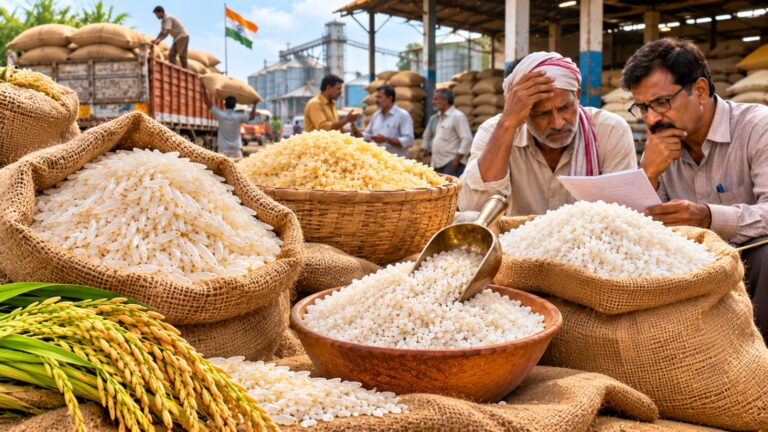

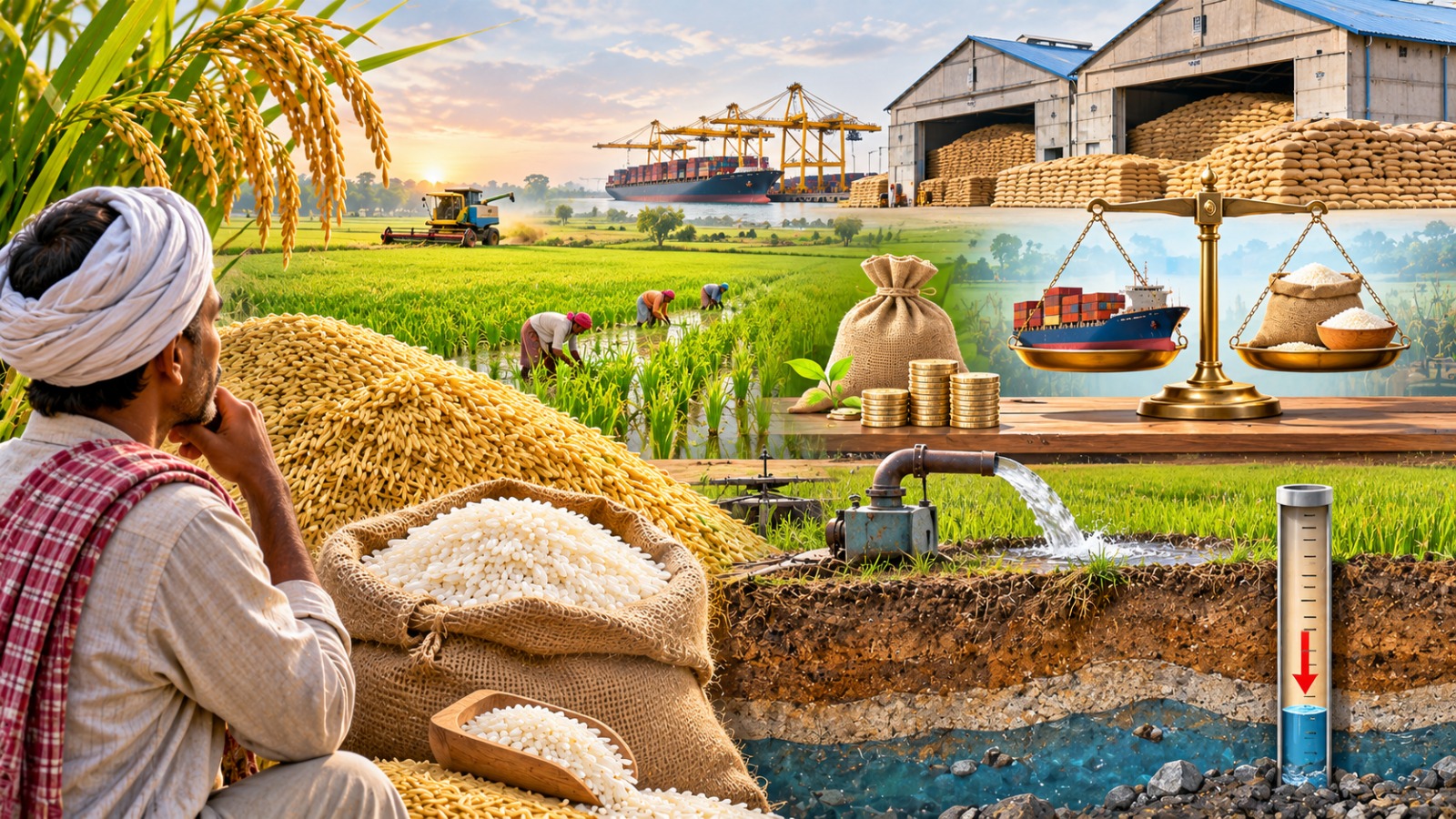
India is facing a growing policy dilemma relating to its emergence as the world’s largest rice exporter- as production has boomed and export levels have risen, while government expenditure has also grown. With the help of biotechnology and minimum support (MSP) prices, along with extra state government benefits, India’s rice production has almost doubled in the last 10 years. It hit an all-time high of 154 million tonnes in 2025-26. While production has far outstripped local demand, surplus rice is increasingly being exported.
India produced a surplus of rice equivalent to around 107 million tonnes more than it consumed in 2025-26, according to a Reuters investigation dated November 18.
India has also become even more dominant in world rice trade. Over the last 10 years, Indian rice exports have doubled to 22.3 million tonnes in 2025. Around 40 per cent of world rice trade is now carried out by India and its relatively low export prices are affecting competitors’ markets.
Concerns are mounting regarding the financial, warehousing and groundwater implications of the increasing rice surpluses, alongside the need to re-define India’s agricultural policy.
50% boost in production as flood resistant strains developed
High yielding and flood resistant rice strains have been key in boosting Indian rice farming.
Following the commercial launch in 2009 of a strain called Swarna-SUB1, which is able to resist flooding, rice farming has been expanded particularly in eastern parts of the country prone to flooding.
Scientists in India transferred the flood-resistant qualities of a strain known as FR13A into another popular strain, Swarna, to produce the new rice. This has enabled farmers to better tolerate flooding and thus minimise yield loss.
Significant increases in rice farming have been seen in Bihar and Odisha
Over 15 years, Bihar increased rice farming to 8.75 million tonnes – a rise of 182%. Levels in neighbouring Odisha rose by 50% to 10.2 million tonnes.
Scientists are currently developing dual purpose strain which can resist both floods and drought and so enable farmers to respond to increasingly erratic monsoons.
New rice strains could boost India’s production by at least 10 million tonnes within the next five years, according to Reuters.
NITI Aayog has also predicted that by 2036, India’s rice production could grow still further to 171 million tonnes. Meanwhile, India’s own rice consumption may only rise to about 110 million tonnes.
Without a change to agricultural policy and effective demand control, this could exacerbate the current production and demand imbalance.
Growing surpluses lead to rising subsidy bill
Whilst increased rice farming has contributed to both India’s food security and export capacity, it has also resulted in a marked increase in government spending. Over the last 10 years, India’s centre government food subsidies have more than doubled to Rs 2.28 lakh crore in 2025-26. And of this, rice subsidies constitute just under three-quarters of expenditure.
India’s subsidy regime, which was established in the 1960s in response to food scarcity, was designed both to guarantee food provision and to secure good farmer income.
The Centre sets an MSP for paddy, and then government bodies purchase rice from farmers. Furthermore, various rice farming states provide additional top-ups to the central government’s MSP to further stimulate farming.
But as production has grown there have been concerns that increasingly government money is being spent on rice which is then exported at competitive prices.
Agricultural economist and ex-government advisor Ashok Gulati has expressed doubts about the economic consequences of subsidising rice that is sold abroad.
Furthermore, the government faces pressure to reform purchasing benefits and shift agricultural focus to less water demanding crops such as pulses and oilseeds – areas where India continues to be highly reliant on imports.
Surpluses also prompt government to seek non-food related rice applications
As well as affecting purchasing and subsidies, the rising level of rice surpluses is also affecting India’s warehousing capabilities.
India’s government rice reserves stood at a record high of 55.47 million tonnes on October 1, 2026. This is over quadruple the required level of buffer stock.
Procurement bodies and private milling units particularly in eastern states are encountering problems due to this increased stockpile level.
There is now a major issue regarding the coordination of procurement and stock transfer. Government bodies must have appropriate storage to house newly procured paddy.
To resolve these issues, the Food Ministry has suggested an extra 13.1 million tonnes of storage space should be created.
Punjab is especially affected. Here there have been concerns regarding the transfer of past procurements and the storage capacity for forthcoming harvests.
Moreover, the government has been motivated by the surpluses to investigate alternative rice utilisation options, for instance in bioethanol manufacture.
India’s cost-competitive exports
As already explained, India has further enhanced its influence on world rice pricing through its enlarged export surplus.
Being responsible for around 40 per cent of the world’s rice trade, Indian exports are highly influential in global markets.
Indian rice was selling in mid-November for some $110 less per tonne than benchmark Thai rice, which itself was priced at around $497 per tonne.
Whilst this has bolstered India’s competitiveness amongst importing countries, it has also prompted concern from competing exporters.
Thais, Vietnamese and American producers have all voiced concerns at how India’s subsidised production and export pricing affects world market competition.
The U.S. has in the past criticised India’s rice subsidy arrangements, claiming that they result in an unlevel playing field for other exporting nations.
Thailand has also advocated closer co-operation between leading rice producing countries to avoid undue market price rivalry.
For importing countries, India’s competitive and cost-effective rice exports are highly valuable. Yet for other exporting countries, India’s expanding subsidised rice supply represents a major area of concern.
Rice and oilseed/pulse subsidies are seen in conflict
Yet another issue to arise from India’s developing rice industry is the perceived cost of persisting with subsidies for relatively water demanding paddy farming.
Despite strong agricultural production capability, India is still highly reliant on imports for both edible oil and pulse supply.
Oilseeds and pulses import bills totalled some $22.7 billion in 2025 – a 120 per cent rise on a decade ago. By contrast, rice export revenue was around $12 billion.
Furthermore, rice farming is also more fertiliser intensive than many other farming sectors and so the government’s fertiliser subsidy bill is also affected.
It is predicted to surpass Rs 3 lakh crore in 2026-27 – some quadruple the figure from 10 years ago.
In addition, water-intensive rice farming is causing strain on groundwater supplies – particularly in areas where groundwater is heavily used for irrigation.
Whilst the Finance Ministry has advised states to ensure that agricultural policies are in line with national objectives and to promote a move away from highly water demanding farming, there are political difficulties in decreasing procurement top-ups which are seen by states as vital for farmers.