
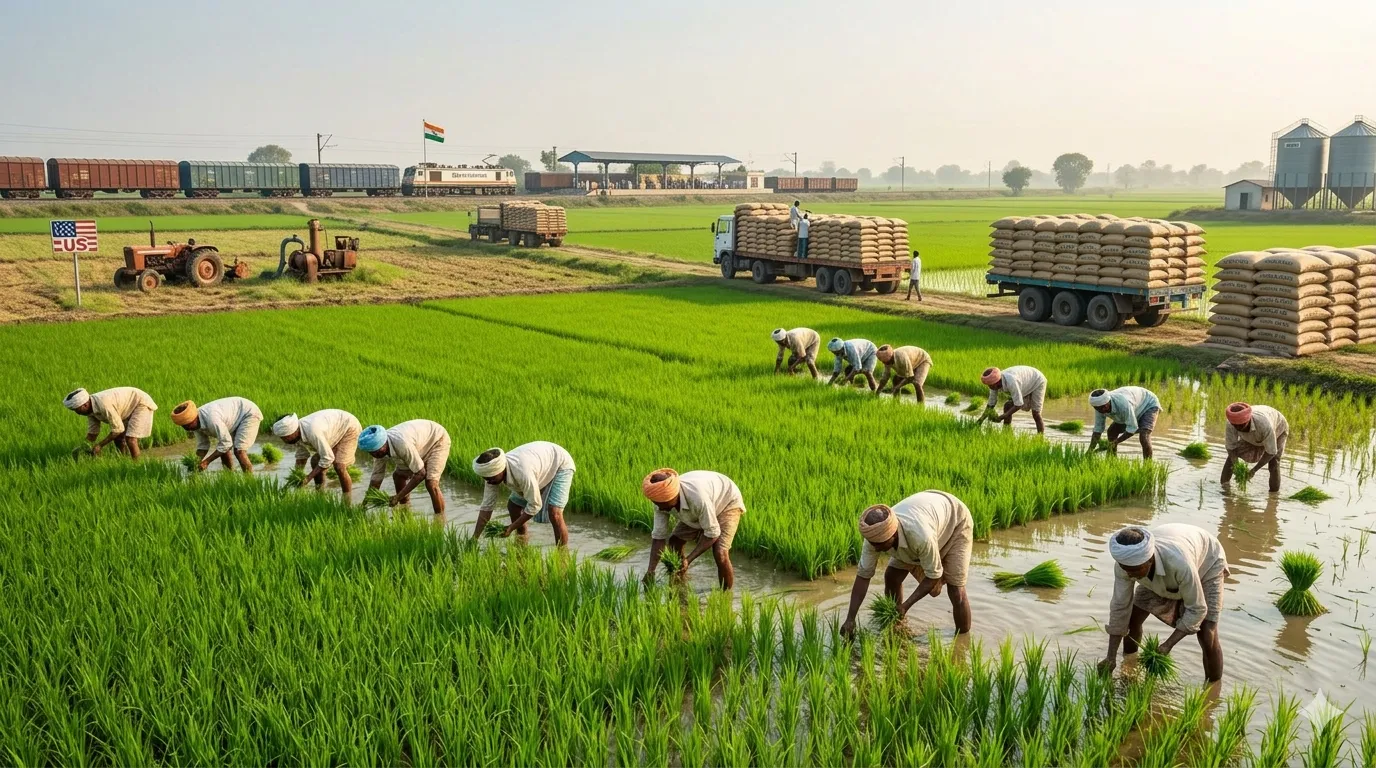
US Rice Acreage Decline 2026 Global Opportunities Open for India
The US rice acreage decline in 2026 is emerging as a key development in global agriculture, with farmers in Arkansas expected to significantly reduce rice cultivation. Reports indicate that rice acreage may fall by nearly 24%, as farmers shift towards more profitable crops like soybeans, which are projected to see a 20% increase in acreage. This trend reflects changing agricultural economics in the United States and could have major implications for global rice trade.
US Rice Acreage Decline and Shift Toward Soybeans
The US rice acreage decline is largely driven by rising production costs, high water usage, and volatile global prices. In contrast, soybeans are benefiting from strong domestic demand and steady export opportunities, making them a more attractive option for farmers.
Along with rice, acreage for other crops such as cotton, corn, and peanuts is also expected to decline in Arkansas. This shift highlights a broader transition in US agriculture, where profitability and resource efficiency are becoming key decision-making factors for farmers.
Implications for Global Rice Trade
The US rice acreage decline could tighten global rice supply, potentially leading to stable or higher international prices. As the United States is one of the major rice exporters, reduced output may create opportunities for other exporting countries to capture additional market share.
This comes at a time when global rice markets are already experiencing shifts. In India, summer rice acreage has declined, but pulses and oilseeds are gaining ground due to crop diversification. Meanwhile, export opportunities are opening up through developments like the South Korea rice tender, which is seeking high-quality rice imports.
At the same time, the Philippines safeguard probe on imported rice highlights rising protectionism, which could reshape trade flows, especially affecting countries like Vietnam.
Why This Is Good News for India
For India, the US rice acreage decline presents a strategic opportunity. As the world’s leading rice exporter, India is well-positioned to fill any supply gaps created by reduced US production. Indian non-basmati rice is already competitive in price and quality, making it attractive for buyers in Middle East, Africa, and Europe.
Additionally, government support through measures like the fertiliser subsidy 2026 ensures that farmers have access to affordable inputs, helping maintain stable production levels during the Kharif season. This strengthens India’s ability to meet rising global demand.
However, experts suggest that India should not rely on a single opportunity. Instead, focusing on market diversification, value-added rice exports, and quality standards will be key to sustaining long-term growth in international markets.
A Bigger Picture of Global Agriculture Trends
The US rice acreage decline is part of a larger global trend where farmers are adapting to changing market conditions. Across countries, decisions are increasingly influenced by profit margins, climate challenges, and input costs.
India’s shift toward pulses and oilseeds, South Korea’s demand for diversified rice imports, and the Philippines’ move toward safeguard measures all point to a rapidly evolving agricultural landscape. These developments underline the importance of flexibility and strategic planning in modern farming and trade.
Conclusion: US Rice Acreage Decline Creates New Opportunities
The US rice acreage decline is not just a regional shift but a global signal. As US farmers move toward soybeans, the resulting supply gap in rice can benefit countries like India. By leveraging strong production, government support, and expanding export markets, India can strengthen its position in global rice trade. At the same time, adapting to changing trade policies and market dynamics will be crucial to fully capitalize on the opportunities created by the US rice acreage decline.