
India saw a 6.7 percent year-on-year rise in non-basmati rice exports for the April-October period of the 2026/27 year to 8.84 million tonnes – up from 8.28 million tonnes.
Official trade data shows that in the same period, Indian non-basmati white rice exports rose by 18.3 percent to 2.82 million tonnes and broken rice by an impressive 73.5 percent to 0.98 million tonnes. Exports of these two types of rice thus showed strong growth in comparison to the prior year figure of 2.38 million and 0.56 million tonnes respectively.
Nevertheless, exports of parboiled rice – historically an important part of India’s non-basmati rice export basket – fell by 4.6 percent for the seven month period to 4.9 million tonnes, down from 5.1 million tonnes in the preceding year.
This illustrates a clear move away in India’s non-basmati export mix towards more white and broken rice, as demand for these products has grown and offset the reduction in parboiled rice exports.
White and broken rice lead the way
India’s exports have been fuelled by good value-for-money Indian rice.
Between April-October, Indian exports of white rice rose by nearly 4.4 lakh tonnes and those of broken rice by some 4.2 lakh tonnes, in comparison to last year.
Conversely, parboiled rice exports fell by about 2.3 lakh tonnes, highlighting a shift in demand.
Parboiled rice exports also encompassed 42,558 tonnes of high quality rice which bore Geographical Indication (GI) designations.
It would appear that Indian exporters are currently enjoying the enhanced demand for well-valued rice. Price and access continue to play an important role for many importing countries.
Export volumes do not translate into higher export prices
Whilst there has been an increase in Indian rice exports, the export price that India has received has been negatively affected by reduced average export pricing.
India’s non-basmati rice exports rose by 6.4 percent to 15.04 million tonnes in the 2025/26 year from 14.13 million tonnes in 2024/25. Yet, the value of these exports fell to $5.87 billion from $6.53 billion.
The average export price consequently fell to around $390 a tonne in 2025/26, from $462 in the preceding financial year.
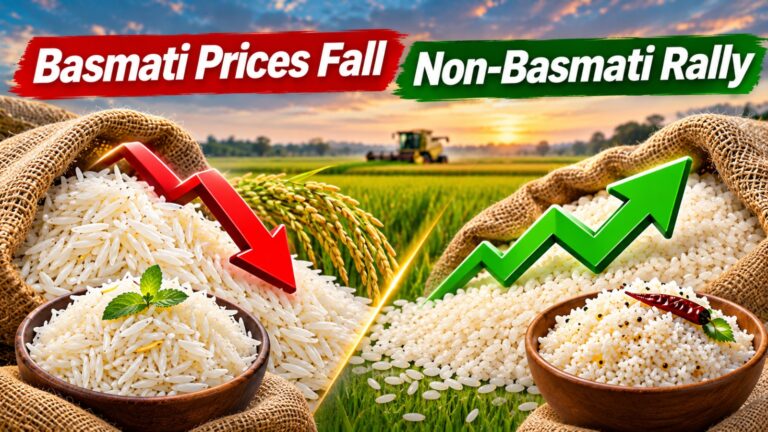
An identical pattern was evident for basmati. Despite a year-on-year growth in basmati exports of 7.6 percent to 6.52 million tonnes in the 2025/26 year (from 6.06 million tonnes), average export prices fell by 13 percent to around $870 a tonne.
Basmati rice exports were relatively steady at around 3.6 million tonnes for the April-October period of the 2026/27 year. These statistics emphasise the difficulty that India has in increasing both its export volumes and market share, whilst simultaneously enhancing the export price it can receive.
Domestic price pressures attract government attention
As Indian rice exports achieve strong results, domestic rice prices are being driven higher and the government is looking at what steps it may take to enhance supply levels and help to ease retail price rises.
Indeed, retail rice inflation stood at 12.51 percent in October 2026 and there are concerns over the effect that this is having on consumers.
Whilst the government is thought to be exploring targeted interventions such as export duty and minimum export pricing policies, it is not immediately intending to impose a total export ban.
Exporters, however, point out that recent domestic price growth has predominantly occurred for high-end local rice varieties such as Kalanamak, Katarni, Seeraga Samba and Gobindobhog. Typical rice types have in fact not shown such marked price rises.
Industry sources have also expressed concern at the additional premiums being paid by the states of Odisha and Chhattisgarh for popular paddy types. They suggest that the higher-than-usual purchase prices may well then affect retail pricing.
Striking a balance between export and domestic food inflation
India has retained a strong position within world rice exporting markets. As previously highlighted, its export volumes have been bolstered by increased product flows of white and broken rice.
Yet, the country now faces the difficult task of managing falling export prices and growing domestic rice prices.
If export activity is curtailed, India must consider how this may affect its international market competitiveness. Furthermore, it opens a door for rival nations such as Thailand, Vietnam and Pakistan to step forward.
Over the coming months, the development of India’s rice trade will hinge upon the effects of government policy, domestic procurement practices and world demand.
India needs to continue to effectively compete within global rice markets, but at the same time ensure sufficient domestic supply and stable retail pricing.