
China Harvests Rice Grown in Space: Could Space Farming Feed Future Astronauts on Mars?
China Harvests Rice Grown in Space: Could Space Farming Feed Future Astronauts on Mars?
Can rice really grow hundreds of kilometres above the Earth? Can astronauts grow fresh food on Mars to survive, rather than bringing food packages with them? China’s latest experiment on the Tiangong Space Station seems to be a step towards making this a reality.
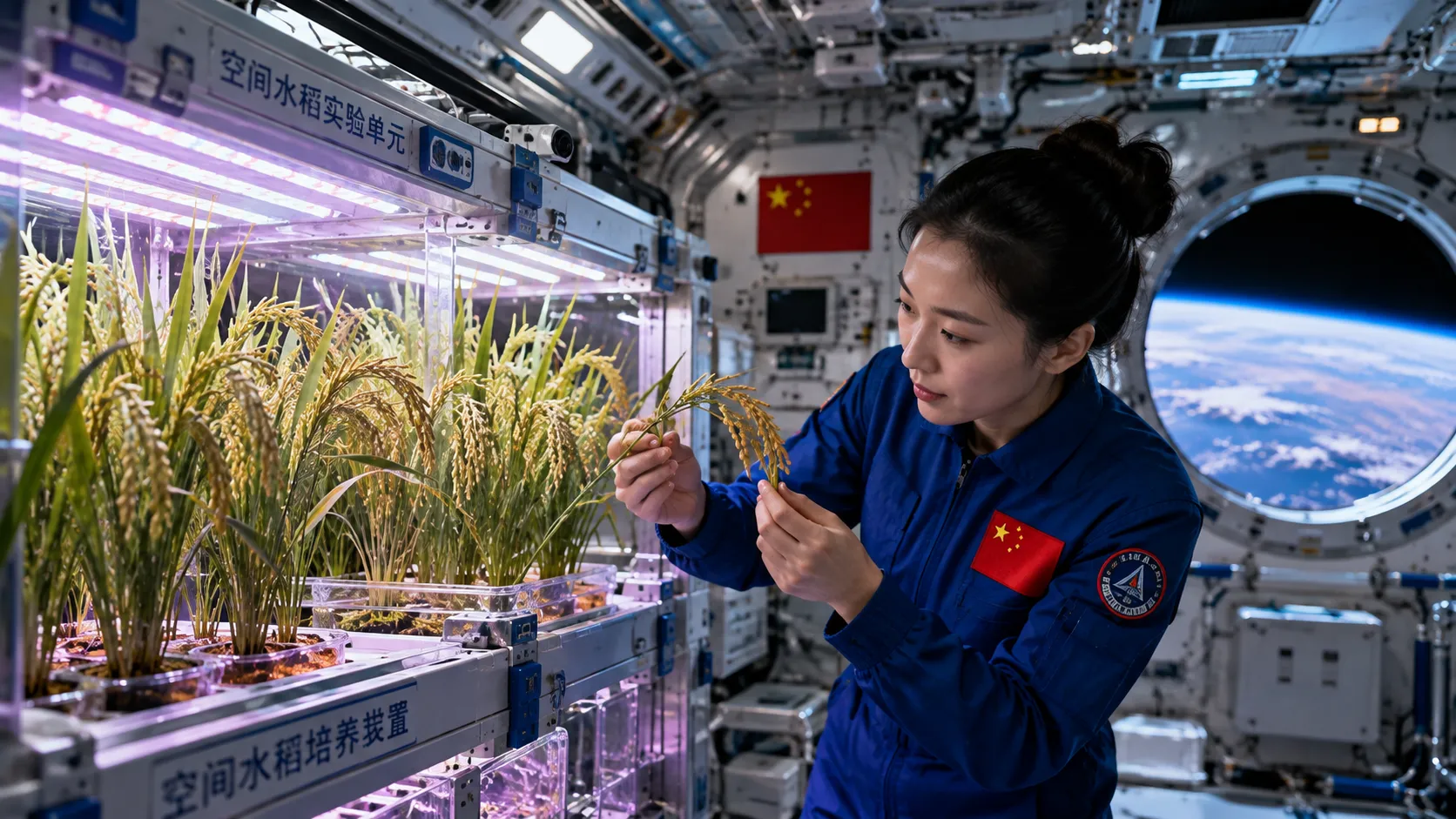
China has managed to harvest rice grown in the conditions of space on the Tiangong Space Station. This is another step towards ensuring there is enough to eat on expeditions far away from Earth.
The experiment was carried out by the Shenzhou-23 crew, who grew rice in Tiangong for more than two months in specially prepared conditions. Researchers are looking into whether rice can be grown for several generations in space.
Why is it so important for us to grow rice in space?
Long-term space flights, to the Moon, or, more remotely, to Mars, will require us to think about food. If we can grow food, this will save us both distance and time in transporting it.
As for why rice, it is one of the most popular cereals in the world, and its cultivation has been studied for quite a long time. The fact that rice can be grown in space will provide us with many answers about growing other crops in space.
There Is Nothing Simple About Growing Plants in Space
We have grown plants on Earth, while gravity has been pulling them down, but when gravity disappears, the simplest things become complicated. The root system is confused since the direction of growth is not clear to it, and water clings to the leaves in large blobs – instead of soaking the plant, it rolls off. Moreover, there is the complication of pollination, which does not always work in zero gravity.
In other words, to make it possible for plants to grow in space, you need to know not only how they behave in zero gravity but also what they need to live and reproduce.
China’s Earlier Rice Experiment Made History
In 2022, Chinese researchers announced that they had completed the first-ever test of a food crop – rice – growing rice in all the conditions of a space flight. Six rice seeds were sent into space, and they produced 59 new ones. This means that the scientists managed to grow rice fit for further cultivation during their year-long experiment in Tiangong.
Thus, this year, China announced another successful experiment with rice in space, which is a step towards understanding not only the ability of rice to grow outside the Earth but also to reproduce there.
Why Is That So Important to Us?
While one harvest of rice will help us solve the immediate problem of food in space, multiple harvests are needed to find out how plants can thrive in space.
Plants Could Do More Than Provide Food
They can take care of us and the planet at the same time. While in Earth, the air we breathe, the fresh water, and the food we eat are inextricably linked, in a spacecraft, plants will help to create a self-sustaining ecosystem, part of which we will be. They will take care of the air we breathe and, possibly, recycle the water we drink. However, right now, creating a closed-loop life support system is an unsolved problem of astrophysics.
In other words, a long space journey will eventually be possible without resupply missions from the Earth. It is only a matter of time before we figure out exactly how to do it.
So What About Growing Rice on Mars?
There, plants will have to withstand temperatures as low as – 100 degrees Celsius, a shortage of oxygen, and cosmic radiation. There is also a problem with the composition of the soil, which is unsuitable for food crops. In other words, we will need to create ideal growing conditions for crops on another planet.
However, experiments in Tiangong may have answers to some of these questions.
If scientists manage to grow rice, and more importantly, make it reproduce, they will get closer to developing the technology to do the same in space. This will allow them to grow not only rice but also other food crops, which will greatly facilitate long-term space missions.
From Paddy Fields to Spaceships
Rice has always been associated with fertile fields, irrigation, and rivers, but now our thoughts are turning to the stars. It turns out that there is a possibility for rice, just as for people, to explore the universe. China’s experiments do not yet give us a complete solution to feeding astronauts on Mars, but they do provide at least another data point for research.
Scientists are currently working on figuring out how to get food crops to thrive beyond Earth and how to keep them thriving. It is our job to look forward to how their work will make it possible for rice to become more than a staple crop here on Earth.