
India’s Egg Exports Decline Amid Middle East Conflict
India’s Egg Exports Decline Amid Middle East Conflict
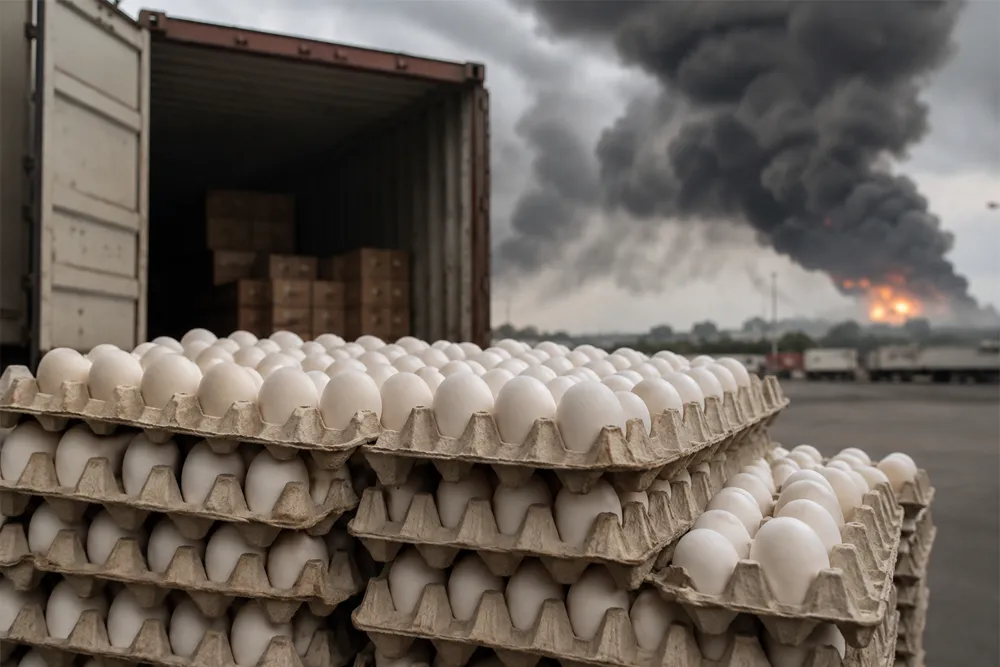
Recently, India’s egg export market has been witnessing the impact of the Middle East Conflict since shipments to major Gulf destinations have slowed due to freight costs, and trade routes face disruptions. According to trade data, exports of India’s Poultry declined around 20 per cent in March.
Moreover, Shipments to the UAE dropped 19 per cent year-on-year, whereas poultry exports to Oman reduced by around 90 per cent. The drop in the egg supply chain has affected the egg producers in Tamil Nadu. The crisis is not limited to exports. It is also expected to raise costs for Indian consumers as poultry producers struggle with rising input prices. Not only this, prices of corn and soybeans, key ingredients in poultry feed, have nearly doubled in recent months. According to Industry executives, the supplies are expected to remain tight until the next harvest cycle in October-November, which will keep pressure on poultry farmers. Furthermore, higher fuel prices have added another layer to India’s egg exports by increasing transportation and packaging.
Notably, the government has raised fuel prices by nearly Rs 8 over the past two weeks. However, some industry participants believe the domestic market may ease part of the export slowdown. Generally, India’s annual egg production is estimated at 149.11 billion eggs, of which roughly 95 per cent to 98 per cent is consumed domestically. However, redirecting export-oriented supply into the domestic market would likely come at the cost of lower margins for producers. Export realisations in FY26 averaged nearly Rs 6.9 per egg, compared with Rs 6.2 a year earlier. By contrast, the median domestic market price was at only Rs 5.3 per egg, more than 30 per cent lower than export prices.