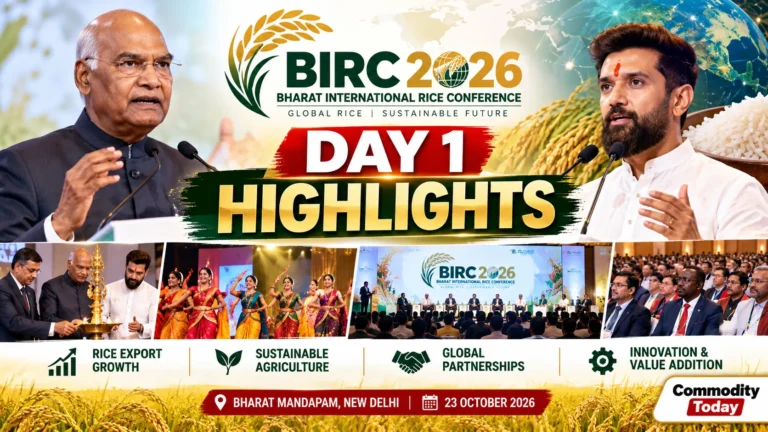

BIRC 2026 Day 1 Highlights: Ram Nath Kovind, Chirag Paswan Spotlight India’s Rice Export Growth and Global Trade
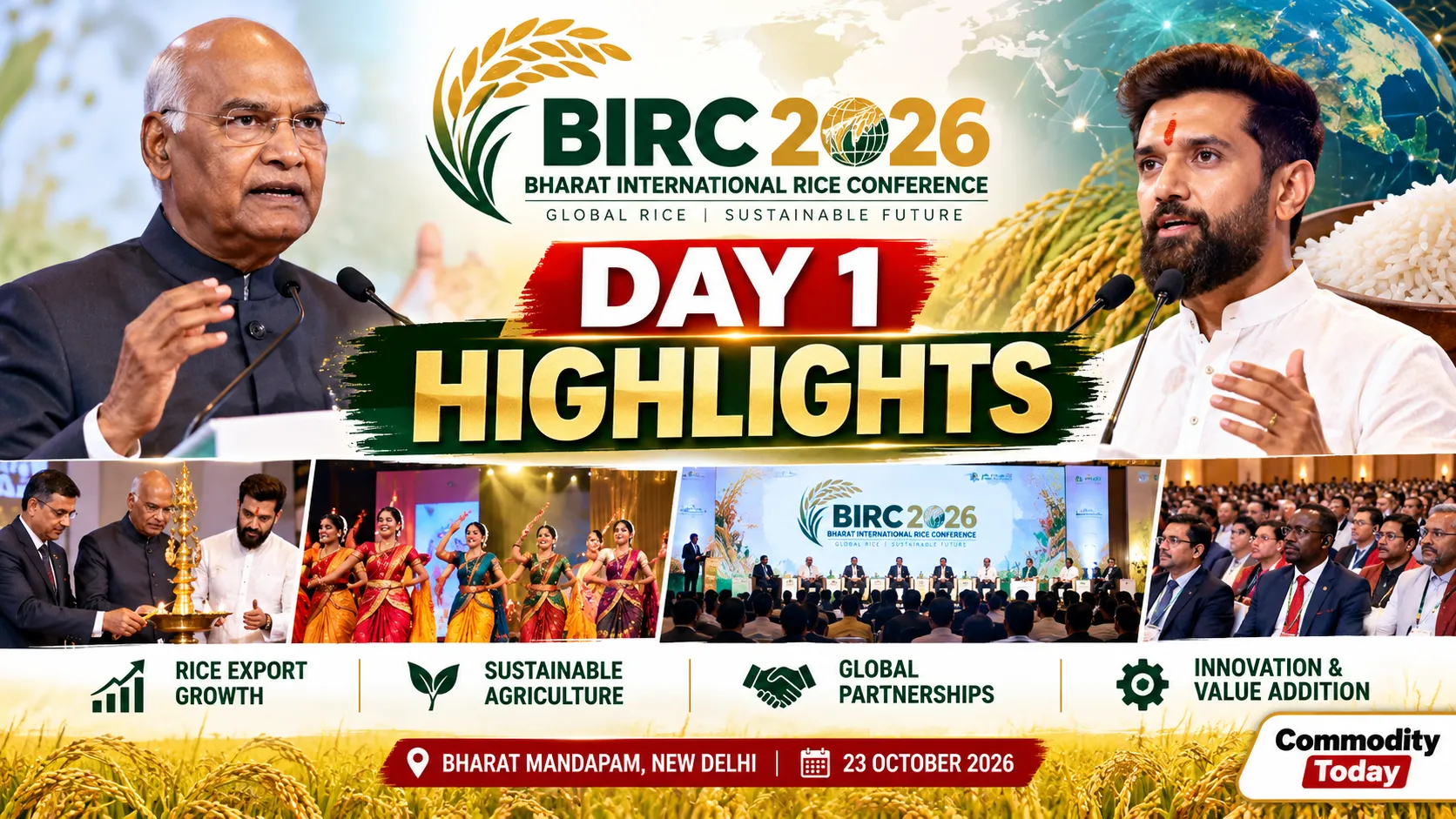
BIRC 2026 Day 1 Highlights: Ram Nath Kovind, Chirag Paswan Spotlight India’s Rice Export Growth and Global Trade
5:26 PM | Session 3
LIVE UPDATE | BIRC 2026: Experts Highlight Safe Payment Practices for New Exporters
An audience member asked about safe payment practices for budding exporters. The discussion highlighted the importance of maintaining clear email communication with buyers, asking the right questions and holding initial discussions to establish expectations before proceeding with export transactions.
5:26 PM | BIRC 2026: Yash Jangid Highlights Key Steps to Protect Export Payments
During Knowledge Session 3 on Documentation, Insurance & Credit, Yash Jangid emphasised the importance of choosing the right contractual terms for export transactions and verifying the facts before proceeding with a buyer. He advised exporters to protect their documentation, maintain engagement with buyers, notify ECGC on time and use collection support when payments become overdue. These measures can help exporters manage payment risks and strengthen recovery efforts in international trade.
5:17 PM
UPDATE 1 | BIRC 2026: Buyer Verification and Export Credit Risk in Focus
Knowledge Session 3, Documentation, Insurance & Credit: Protecting Export Payments, Reducing Bad Debt and Avoiding Disputes, highlighted the importance of managing financial risks in international trade. Dr. Hansa Shingrakhia stressed the need for thorough buyer underwriting, including checks on identity, ownership, business track record, financial capacity and payment behaviour. She noted that exporters can face risks even when buyers may not perceive the same level of exposure. Advance payment can help protect exporters, although securing 100% advance payment from international buyers may not always be possible.
UPDATE 2 | BIRC 2026: Accurate Documentation Key to Protecting Rice Export Shipments
The session emphasised that documentation gaps can put export cargo and payments at risk. Speakers highlighted the importance of maintaining complete and accurate export documents and discussed the potential role of digital platforms and AI technology in improving documentation processes. Proper documentation was presented as a critical step in ensuring smoother transactions and reducing the risk of disputes.
UPDATE 3 | BIRC 2026: Exporters Urged to Understand ECGC Credit Insurance
Arun Ambar of MM Consultants highlighted the importance of credit insurance in protecting exporters against payment defaults. He advised exporters to contact the Export Credit Guarantee Corporation (ECGC) if payment remains outstanding beyond 30 days and noted that claims must be filed within 60 days, as discussed during the session. The discussion also indicated that ECGC coverage may reach 80–85%, depending on the applicable policy. Speakers cautioned that claim settlement can take at least a year and advised exporters to read policy terms carefully before relying on credit insurance.
4:25 PM | BIRC 2026: Global Rice Markets, Export Opportunities and Value Addition in Focus
The second knowledge session at the Bharat International Rice Conference (BIRC 2026), titled Top 10 Rice Markets to Watch in 2027: Demand Signals and Entry Strategies, explored emerging opportunities in international rice markets, changing import policies, pricing competitiveness and India’s export potential. The session was moderated by Manisha Gupta, Commodities Editor at CNBC-TV18.
BIRC 2026 Highlights India’s Rice Export Potential
Dr. Prem Garg highlighted India’s strong domestic rice supply and buffer stocks while discussing the country’s ability to sustain its position in global markets. He projected that India could export 20–25 million metric tonnes of rice annually. He also noted that Nigeria imports rice in large volumes and that Madagascar imported rice this year, reflecting opportunities across international markets.
The discussion addressed concerns about disruptions in the global rice industry and the sustainability of India’s export growth. Rising rice prices were attributed to demand and the potential impact of El Niño, while competition from Vietnam remained an important market consideration.
Global Demand and Market Access
The session examined rice market opportunities across Africa, Europe, the Gulf, Asia, and North and South America. Discussions on West African markets highlighted changes in import policies in Nigeria, Benin and Burkina Faso, underlining the importance of understanding country-specific regulations and market-entry requirements.
India’s Competitiveness and Value Addition
Nitin Gupta highlighted India’s position as a highly competitive rice supplier in international markets. Audience questions focused on how India could strengthen its position in non-basmati rice amid competition from other exporting countries. Regional varieties such as Govindobhog and Sona Masoori were discussed as part of India’s diverse rice offering.
Manisha Gupta emphasised value addition as an important consideration for the industry. The session at BIRC 2026 highlighted the need to combine competitive pricing, market-specific strategies and value addition to strengthen India’s presence in global rice trade.
4:20 PM | BIRC 2026: India’s Rice Export Growth and Market Disruptions Discussed
During Knowledge Session 2, Top 10 Rice Markets to Watch in 2027: Demand Signals and Entry Strategies, Dr. Prem Garg discussed changing global rice trade patterns, highlighting Nigeria’s large-volume rice imports and Madagascar’s imports this year. Addressing concerns about disruptions in the rice industry and India’s export growth, he pointed to the country’s large states and strong buffer stocks.
Dr. Prem Garg Projects India’s Rice Exports at 20–25 Million Tonnes Annually
Dr. Prem Garg said India could sustain rice exports of 20–25 million metric tonnes annually. He noted that India produced around 149 million metric tonnes of rice this year, while basmati exports stood at approximately 11.5 million tonnes last year and are expected to be around 11 million tonnes this year. He attributed rising prices to demand and El Niño-related concerns, alongside competition from Vietnam.
India’s Rice Competitiveness: Pricing and Value Addition in Focus
During the audience discussion, Nitin Gupta highlighted India’s position as the world’s cheapest rice supplier. Questions also focused on how India can remain competitive in non-basmati rice amid competition from other exporting countries. The discussion highlighted the role of regional varieties, including Govindobhog and Sona Masoori, in strengthening India’s market presence. Manisha Gupta emphasised value addition as an important consideration for the industry.
4:01 PM | BIRC 2026: Dr. Prem Garg Highlights India’s Rice Export Potential
Speaking during Knowledge Session 2, Top 10 Rice Markets to Watch in 2027: Demand Signals and Entry Strategies, Dr. Prem Garg highlighted India’s strong rice supply position and export potential. He stated that India has sufficient rice stocks, including basmati, and noted that Indian rice exports are growing by over 14%. He projected that India’s rice exports could reach 23.5–24 million metric tonnes next year.
3:50 PM | Philippines Rice Market: Production Decline and Import Trends in Focus
Tanya Rana of S&P Global highlighted the Philippines as the largest rice importer, noting that production has declined due to reduced harvested area and El Niño impacts. The market is also facing competition from Vietnamese rice pricing, while the Philippine government has introduced measures affecting imports, including a ban on 5% broken rice.
Meanwhile, Thailand and Vietnam rice prices are rising amid higher paddy prices. India remains highly competitive in the international rice market. The session also discussed BULOG’s rice import activities and future plans.
3:44 PM | Indian Basmati Rice Expands Its Presence in Gulf Markets
Saudi Arabia continues to be a consistent market for basmati rice, with Qatar and Yemen also among the buyers. Indian rice is gradually capturing a larger share of this market growth, highlighting expanding opportunities for Indian rice exporters across the region.
3:42 | APEDA Highlights Rice Customisation and Quality Certification
Shubham from APEDA highlighted the importance of market customisation in rice exports, with Indian rice being exported to multiple countries with different quality and variety requirements. He noted that certification details are available on the APEDA website and that IRRI has identified 12 rice varieties. Japan requires varieties suited to sticky rice, while basmati remains a premium rice variety. Rice testing and quality requirements are also among the initiatives being addressed by APEDA.
3:42 | Basmati Rice Trade Faces Demand Disruptions Amid Geopolitical Tensions
Nitin Gupta highlighted the disruptions in Indian basmati rice trade amid the US–Israel war, noting that fresh demand and orders for basmati rice were affected, with several markets facing difficulties from mid-May. He added that the previous year was also challenging. According to the latest update shared during the session, the basmati crop is broadly similar to last year’s crop, while buyers continue to hold good stocks.
3:30 PM | Knowledge Session 2
BIRC 2026: Top 10 Rice Markets to Watch in 2027
Knowledge Session 2 at the Bharat International Rice Conference (BIRC) 2026, titled Top 10 Rice Markets to Watch in 2027: Demand Signals and Entry Strategies, focused on rice market opportunities across Africa, Europe, the Gulf, Asia, and North and South America. The session was moderated by Manisha Gupta, Commodities Editor at CNBC-TV18.
West African Rice Import Policies Evolve
The session highlighted changing rice import policies in West Africa. Nigeria reduced import tariffs on bulk rice (over 5 kg) from 70% to 47.5%, while tariffs on broken rice fell from 70% to 30%. Benin introduced stricter requirements for rice importers, including a CFA 1 billion guarantee and a commitment to import 50,000–100,000 metric tonnes per month. Burkina Faso suspended rice imports and halted Special Import Authorizations to support domestic production.
Nigeria Rice Market: Export Compliance and Logistics in Focus
The session outlined key requirements for accessing Nigeria’s rice market, including APEDA and DGFT registration for exporters, e-Form M and NAFDAC approval for importers, and the necessary export and shipping documentation. Shipments can move from Indian ports, including Mundra, JNPT, Kakinada and Chennai, to Apapa or Tin Can Island in Lagos. The stated shipping timelines range from 18–25 days for direct routes to 30–40 days via transshipment routes.
3:08 PM | BIRC 2026: Global Rice Market Outlook 2027, El Niño and Freight Costs in Focus
The first knowledge session at the Bharat International Rice Conference (BIRC) 2026, titled Global Rice Demand and Supply Outlook 2027, examined the key factors likely to shape global rice availability, trade flows and prices in the coming year. The session was moderated by Mayank Bhardwaj, Lead Reporter at Reuters.
The discussion highlighted how rice prices are influenced by multiple factors, including production, consumption, stock levels, weather conditions, government policies, freight costs, currency movements and buyer behaviour.
BIRC 2026: Freight Costs and Indian Rice Prices
Dev Garg, Vice President of the Indian Rice Exporters Federation (IREF), highlighted the importance of international freight in determining rice export competitiveness. The discussion indicated that Indian 5% broken rice prices could increase by $60 per metric tonne, while cautioning that such price increases may not be sustainable over the longer term.
El Niño and Production Risks
The evolution of El Niño through early 2027 emerged as a key indicator to monitor, given its potential impact on production across Asian rice crop cycles. Indonesia and Vietnam were identified as significantly exposed, while India and the Philippines also face risks, particularly in rabi and second-crop production.
Shifting Demand and Trade Dynamics
According to the session presentation, South Asia and Africa account for all projected demand growth in 2026/27. Vietnam is emerging as the world’s second-largest rice importer, while the Philippines remains an important importing country. The potential for El Niño to increase Indonesia’s import demand was also discussed.
Bullish Outlook and Market Uncertainty
In an audience poll on the scenario most likely to shape the global rice market in 2027, the bullish scenario emerged as the selected answer. Responding to a question on the impact of war on rice prices, Dev Garg said the effect would depend on freight costs and market conditions.
The session at BIRC 2026 underscored the importance of monitoring weather, demand and logistics to navigate uncertainty in the global rice market in 2027.
2:58 PM | Knowledge Session 1 : Global Rice Demand And Supply Supply Outlook 2027.
Global Rice Market Outlook 2027
At BIRC 2026, Knowledge Session 1, “Global Rice Demand and Supply Outlook 2027,” examined the factors shaping global rice prices, including production, consumption, stocks, weather, government policies, freight costs, currencies and buyer behaviour.
India’s Rice Prices and Export Outlook
IREF Vice President Dev Garg highlighted the role of international freight in rice exports. He noted that Indian 5% broken rice prices could increase by $60 per metric tonne. However, such price increases may not be sustainable over the longer term.
El Niño Emerges as a Key Supply Risk
Experts highlighted the need to monitor El Niño through early 2027, as its evolution could determine production losses across Asian rice crop cycles. Indonesia and Vietnam face significant exposure, while India and the Philippines also remain vulnerable, particularly through rabi and second-crop production.
Shifting Demand Centres Reshape Global Rice Trade
South Asia and Africa account for all demand growth in 2026/27, according to the session presentation. Vietnam is emerging as the world’s second-largest rice importer, while the Philippines remains an importer. Experts also discussed the potential for El Niño to increase Indonesia’s import demand.
Bullish Scenario Seen as a Key Market Outlook
During an audience poll on the scenario most likely to shape the global rice market in 2027, the bullish scenario emerged as the answer. Responding to a question about the impact of war on rice prices, Dev Garg said the effect would depend on freight costs and market conditions, adding that such price increases are not sustainable over the longer term.
12:50 PM | Rice Ecosystem 2027: India Eyes Trusted, Sustainable and Healthy Rice
India’s rice industry is looking beyond export volumes to strengthen global competitiveness through 2027 and beyond. The presentation explores export trends, value-added products and three pillars: trusted, sustainable and healthy rice. Concluding with questions for the audience, it asks what annual growth target India should set for rice productivity over the next decade, encouraging discussion on the sector’s future priorities.
12:30 PM | Rajiv Setia Thanks Delegates for Participating in BIRC 2026
Shri Rajiv Setia, President of the Basmati rice industry, extends his sincere thanks to exporters, buyers and all other participants for attending BIRC 2026. Highlighting India’s global presence in the rice trade, he notes that rice exports worth $7.5 billion reach more than 170 countries, underscoring India’s significant contribution to the global rice market.
12:25 PM | Hon’ble 14th President of India Appreciates BIRC 2026 as a Platform for Opportunities
The Hon’ble 14th President of India, Shri Ram Nath Kovind, appreciates BIRC 2026 for providing a valuable platform to bring together global rice industry stakeholders, foster collaboration and create new opportunities for trade, innovation and stronger international partnerships.
12:24 PM | Ram Nath Kovind Stresses Productivity, Technology and Farmers’ Welfare
The Hon’ble 14th President of India, Shri Ram Nath Kovind, calls for improving rice productivity through better seeds, modern farming practices and wider access to technology, particularly for small farmers. Emphasising that agriculture depends on healthy soil, he notes that food security means more than increasing production—it also requires respecting and supporting the people who grow our food. He pays tribute to India’s farmers, the Annadatas, whose efforts sustain the nation’s food security.
12:24 PM | Hon’ble 14th President of India Highlights Rice’s Cultural and Global Significance
The Hon’ble 14th President of India, Shri Ram Nath Kovind, highlights rice’s deep cultural significance in India, noting that Akshat (unbroken rice grains) symbolises prosperity in Indian traditions. He recognises farmers’ efforts to cultivate rice varieties suited to different markets and cultural preferences, while highlighting India’s global reach, with rice exported to 172 countries. He underscores the importance of strengthening India’s position in the global rice trade while preserving its rich agricultural heritage.
12:23 PM | Hon’ble 14th President of India Ram Nath Kovind Highlights BIRC 2026’s Global Significance
The Hon’ble 14th President of India, Shri Ram Nath Kovind, expresses his privilege in joining BIRC 2026, highlighting its role in bringing the global rice community together. Describing it as the world’s largest rice conference, he notes that a small grain of rice carries a much bigger story of civilisation, resources, opportunity and international cooperation. He emphasises how rice has shaped India’s food culture and continues to strengthen bonds across nations.
12:13 PM | Dr Prem Garg Highlights Rice’s Significance and IREF’s Mission
Dr Prem Garg thanks all delegates and participants for joining BIRC 2026, emphasising the vital role of rice in food security, agriculture and the global economy. He highlights the mission of the Indian Rice Exporters Federation (IREF) to bring exporters, shippers and other industry stakeholders together to strengthen the rice sector. Addressing the challenges posed by ongoing wars and geopolitical tensions, he points to rising freight costs and trade-related difficulties, while highlighting India’s resilience and the importance of collective efforts to sustain rice exports and overcome global disruptions.
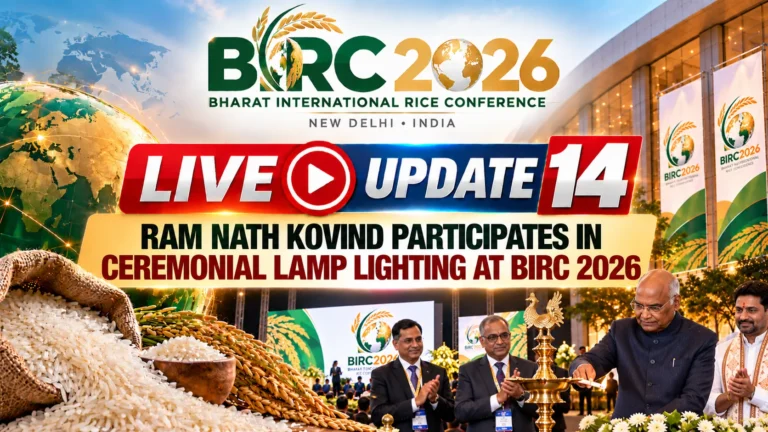
12:08 PM | Ram Nath Kovind Participates in Ceremonial Lamp Lighting at BIRC 2026
Former President of India Shri Ram Nath Kovind participates in the ceremonial lamp-lighting ceremony at BIRC 2026 alongside Dr Prem Garg, Vice President Dev Garg and Rajiv Setia. Dr Prem Garg felicitates Shri Kovind with a ceremonial stole, while a trophy is also presented to the former President during the event.
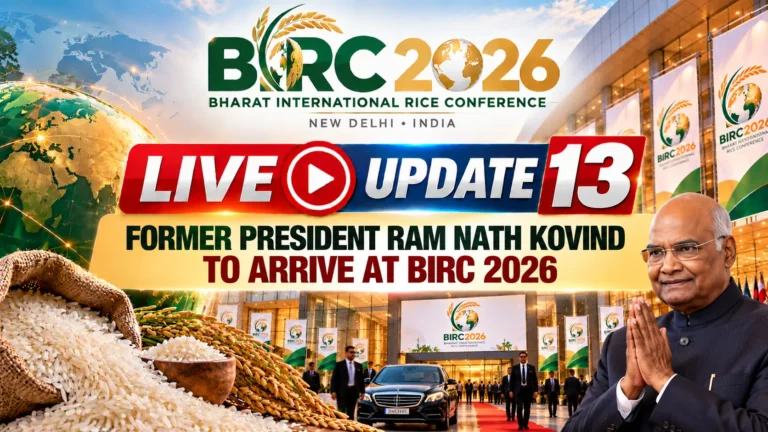
11:58 AM | Former President Ram Nath Kovind Arrives at BIRC 2026
Former President of India, Shri Ram Nath Kovind, the 14th President of India, has arrived at the Bharat International Rice Conference (BIRC) 2026, marking a significant moment at the conference bringing together national and international dignitaries, policymakers and key stakeholders from the global rice industry.
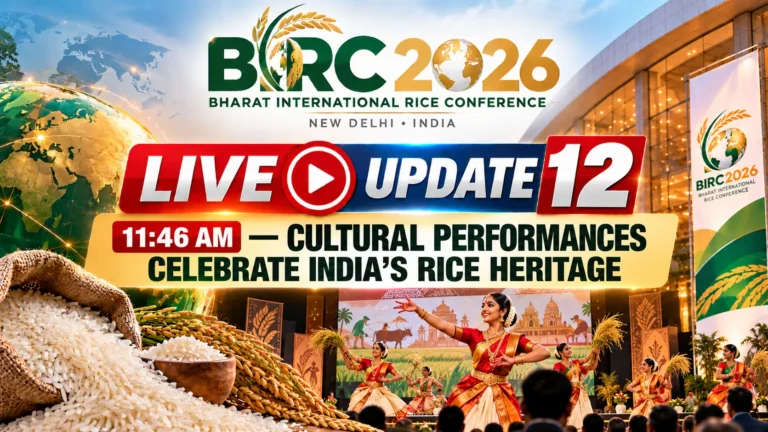
11:46 AM | Cultural Performances Celebrate India’s Rice Heritage
BIRC 2026 presents a fascinating cultural showcase celebrating India’s rich heritage and the deep-rooted connection between rice, agriculture and regional traditions. The performances feature cultural representations from Telangana, Haryana, Chhattisgarh, Andhra Pradesh and West Bengal, highlighting the country’s diverse traditions and the significance of rice in its cultural identity.
11:34 AM | Chirag Paswan Highlights Trade Reforms and Export Growth
Union Minister Chirag Paswan welcomes international delegates to BIRC 2026 and highlights the Government of India’s ongoing reform efforts to strengthen trade and exports. He emphasises the role of Free Trade Agreements (FTAs), international trade partnerships and technological advancement in expanding export opportunities. Stressing the need for seamless processes and ease of doing business, he praises the vision of “One Nation, One Trade, One Policy” to promote greater consistency and efficiency across the trade sector.
11:30 AM | Chirag Paswan Emphasises Value Addition and Paddy Processing
Union Minister Chirag Paswan highlights the importance of Saptadhara and its relevance to agriculture, paddy cultivation and manufacturing. Referring to the vision outlined by the Prime Minister, he stresses that processing plays a crucial role in strengthening the rice sector. He calls for greater focus on value addition to enhance rice quality, improve market opportunities and create greater value across the agricultural supply chain.
11:27 AM | Chirag Paswan Highlights Rice’s Importance and Praises BIRC 2026
Union Minister Chirag Paswan highlights rice as an essential part of daily meals, emphasising its importance in food security and the agricultural economy. Praising the vision behind BIRC 2026, he underscores the need for innovation, creativity and research to improve quality and drive growth in the rice sector. He also notes that the second edition of the conference is stronger than the previous year, reflecting efforts to deliver better outcomes and achieve greater progress for the industry.
11:25 AM | Mozambique Reforms Aim to Simplify Trade Processes
H.E. António do Rosário Grispos, Secretary of State for Trade, Republic of Mozambique, highlights government reforms aimed at simplifying processes and facilitating trade. The reforms reflect Mozambique’s efforts to address challenges and create a more supportive environment for agricultural growth and rice trade.
11:24 AM | Mozambique Highlights Rice and Agricultural Priorities
H.E. António do Rosário Grispos, Secretary of State for Trade, Republic of Mozambique, addresses BIRC 2026, speaking about the importance of rice and agriculture for the country. He highlights Mozambique’s agricultural challenges, the government’s efforts to drive progress, and the opportunities to strengthen the nation’s agricultural sector.
11:23 AM | Dev Garg Addresses the Opening Ceremony
BIRC 2026 Vice President Dev Garg addresses the opening ceremony, introducing the Bharat International Rice Conference and highlighting the conference’s objectives, significance and role in bringing together key stakeholders from the global rice industry.
11:22 AM | Ceremonial Lamp Lighting and the Significance of Grain
Dr Prem Garg and Rajiv Setia join Chirag Paswan for the ceremonial lamp lighting, symbolising an auspicious beginning. The ceremony also highlights the significance of grain as a foundation of food security, livelihoods and agricultural prosperity.
11:21 AM | Chirag Paswan Felicitated by Dr Prem Garg
Dr Prem Garg felicitates Union Minister Chirag Paswan during the opening ceremony of BIRC 2026, recognising his presence at this important industry gathering.
11:21 AM | Vande Mataram Marks the Opening
The opening ceremony continues with Vande Mataram, setting a patriotic tone for the gathering of national leaders, industry representatives and delegates.
11:20 AM | Dignitaries Gather at BIRC 2026
Union Minister Chirag Paswan and other distinguished guests arrive at the conference, bringing together key leaders and stakeholders from the rice and agricultural sectors.
11:20 AM | Opening Ceremony Begins
The Bharat International Rice Conference (BIRC) 2026 begins with a traditional and auspicious start, featuring Ganesh Vandana as distinguished guests and industry leaders take their places on stage.
Lorem ipsum dolor sit amet, consectetur adipiscing elit. Ut elit tellus, luctus nec ullamcorper mattis, pulvinar dapibus leo.