


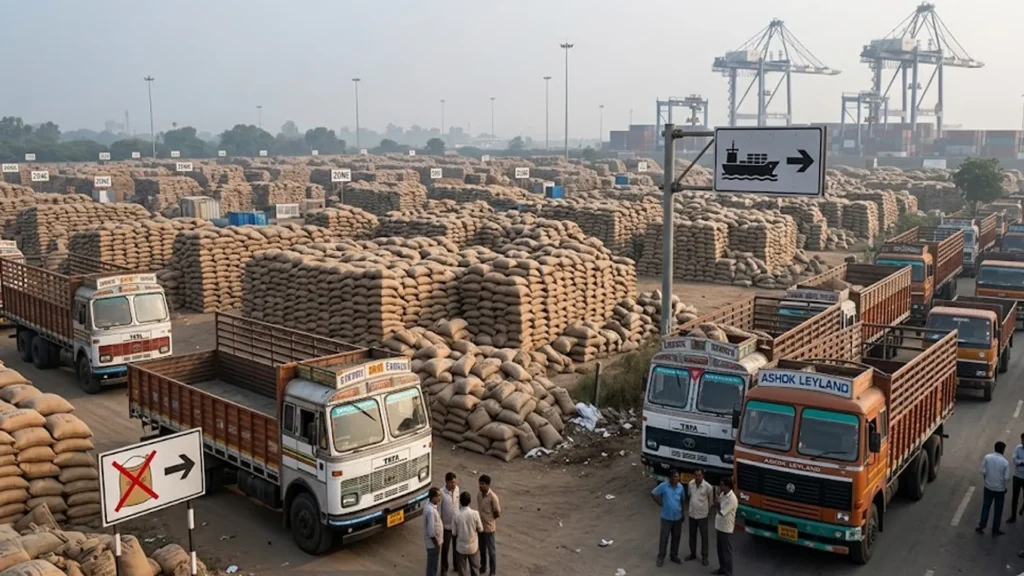
India’s key maritime hub, Kandla Port, is currently facing one of its most severe operational disruptions in recent years, exposing deep vulnerabilities in Indian logistics and significantly affecting Rice exports across the country. Despite record cargo handling in FY 2025–26, the port is now dealing with a crisis driven by global geopolitical tensions and widespread shipping disruption 2026.
Located in Gujarat’s Gulf of Kutch, Gujarat ports like Kandla play a crucial role in India’s trade ecosystem. Kandla alone handles over 160 million metric tonnes of cargo annually, making it the busiest major port in India. However, this achievement has been overshadowed by severe port congestion India, which has disrupted trade flows and exposed structural weaknesses in maritime logistics India.
The crisis escalated after global instability in West Asia disrupted key shipping routes passing through the Hormuz Strait. This triggered a large-scale global trade disruption, forcing shipping companies to reroute vessels via longer, more expensive routes. As a result, vessel arrivals at Kandla Port slowed dramatically, and export operations were severely impacted.
One of the worst-hit sectors has been Rice exports, particularly basmati rice exports from India. Nearly 4 lakh tonnes of basmati rice—equivalent to around 3,000 containers—remained stranded at Kandla and nearby Mundra Port. Exporters were unable to dispatch shipments due to vessel shortages and logistical bottlenecks, leading to a major India export crisis in agricultural shipments.
The disruption in Indian logistics was further intensified as export gate-in operations were suspended and container movement came to a halt. Around 15,000 to 20,000 containers were stuck at the port, creating severe congestion and delaying supply chain movement across sectors including agriculture, fertilizers, and industrial goods.
Freight costs also surged dramatically during this period. Shipping charges that earlier ranged between $800 and $1,500 per container increased to as high as $4,000–$6,500 due to emergency surcharges imposed by global carriers. This escalation worsened the impact on Rice exports, making shipments economically unviable for many traders.
Industry stakeholders have warned that prolonged disruption could damage India’s reputation in global rice markets. Countries in the Middle East, including Iran, Iraq, UAE, and Saudi Arabia, are among the largest buyers of Indian basmati rice. Any instability in supply chains could shift demand toward competing exporters, further intensifying the India export crisis.
The situation has also raised serious concerns about export policy India, which has seen frequent changes in recent years. Sudden shifts in duties, minimum export prices, and restrictions have created uncertainty among global buyers, weakening India’s position in international agricultural trade.
Experts believe that the ongoing crisis highlights deeper structural issues in maritime logistics India, particularly the lack of buffer capacity and limited preparedness for global shocks. Even though Kandla Port continues to expand through projects like new terminals and modernization initiatives, current infrastructure remains under pressure during emergencies.
The impact of port congestion India is not limited to rice alone. Fertilizers, steel, and containerized goods have also faced delays, showing how interconnected Indian logistics is with global supply chains. The crisis has therefore become a broader warning signal for India’s export-dependent economy.
To address these challenges, experts suggest diversifying shipping routes through eastern Gujarat ports alternatives, improving insurance mechanisms for exporters, and introducing more predictable export policy India frameworks. Strengthening digital logistics systems and expanding container handling capacity are also seen as critical reforms.
The shipping disruption 2026 episode has clearly demonstrated that India’s trade ambitions must be supported by resilient infrastructure and stable policy environments. While Kandla Port remains a symbol of India’s maritime strength, the current crisis shows that efficiency alone is not enough without adaptability.
Ultimately, the disruption in Rice exports and basmati rice exports highlights the urgent need to modernize Indian logistics systems to withstand global shocks. Without such reforms, even record-breaking ports like Kandla risk being overwhelmed by future global trade disruption events.